Wildfire Smoke Chemistry Runs in Fast-Forward
Published:
Plain-language summary
Aircraft observations reveal unusually rapid chemistry during the first two hours after emission.
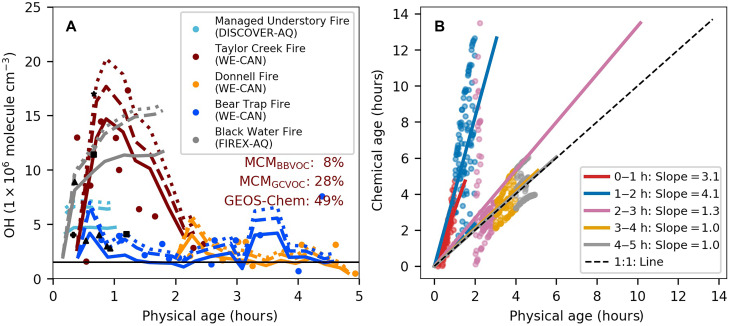
Wildfire smoke does not carry a clock, but its chemistry does. Its chemical age tracks how much oxidation it has experienced. We used observations and modeling to read that clock. In five selected daytime plumes, the first two hours unfolded in fast-forward. After one hour of travel, the smoke had accumulated about as much oxidation as typical background air would in three to four hours.
Research aircraft from three major US campaigns sampled each plume near the fire and again farther downwind, giving us snapshots of how the plume-center chemistry changed during the first five hours after emission.
Four findings
- The sources driving smoke chemistry changed quickly. Radicals such as OH drive many of the reactions in smoke. During the first hour, HONO supplied most of the estimated radical production; as the smoke aged, oxygenated organic gases and ozone became more important.
- Chemical age explained much of the plume-to-plume variability. It accounted for about two-thirds of the variation in ozone enhancement and roughly 40%–70% of the differences in the loss of volatile organic compounds (VOCs) and the formation of ozone and peroxyacetyl nitrate (PAN).
- What controlled ozone production could shift within two hours. In at least two of the five plumes, conditions shifted from VOC-limited or transitional toward NOₓ-limited as the smoke aged. In other words, the limiting ingredients shifted from reactive organic gases toward nitrogen oxides. The formaldehyde-to-nitrogen-dioxide ratio (FNR) is often used to diagnose these conditions in urban air, but the common threshold of 1 missed this early shift in the sampled smoke.
- Models worked better when they represented more of the wildfire VOC mixture. Including a fuller VOC mixture improved agreement with measured ozone and organic nitrates and with OH levels inferred from observations. Current simplified mechanisms therefore need better wildfire VOC representation. PAN was still too high in one of four plumes with measurements, suggesting that some NOₓ loss processes remain missing or too weak.
About the paper
Ozone photochemistry in fresh biomass burning smoke over the United States
Jin et al. Science Advances (2026) DOI: 10.1126/sciadv.ads2157
Media: NSF UM News NBC Montana WeChat feature
Official abstract
The first 5 hours of aging in biomass burning plumes can strongly affect ozone photochemistry. We examine how volatile organic compounds (VOCs), nitrogen oxides, and nitrous acid influence hydroxyl radical, ozone, and peroxyacetyl nitrate (PAN) based on three aircraft campaigns over the United States. Our analyses reveal variable, highly elevated hydroxyl radical concentrations in the first 2 hours, resulting in evident fire-to-fire variability in VOCs oxidation and in ozone and PAN production. About 40 to 70% of the variability is explained by chemical aging. Ozone production in the plumes is usually VOC-limited for the first 2 hours and then nitrogen oxide limited downwind. Box model results for hydroxyl radical, ozone, and most VOCs, using the full, explicit Master Chemical Mechanism (MCM) mechanism, suggest no major gaps in the current best knowledge of gas-phase chemistry. However, the MCM sometimes overestimates PAN due to underestimated nitrogen oxide sinks. GEOS-Chem, a widely used chemical transport model with a reduced mechanism, generally underperforms because of incomplete VOC representation. We identify these critical pathways to guide future model development.
Recommended citation
Jin, L., Coggon, M. M., Permar, W., Juncosa Calahorrano, J. F., Palm, B. B., Gkatzelis, G. I., Robinson, M. A., Bourgeois, I., Hall, S. R., Peischl, J., Ullmann, K., Thornton, J. A., Warneke, C., Flocke, F., Fischer, E. V., Yokelson, R. J., and Hu, L. (2026). Ozone photochemistry in fresh biomass burning smoke over the United States. Science Advances, 12(6), eads2157. https://doi.org/10.1126/sciadv.ads2157