What Happens to Wildfire Smoke After Days in the Air?
Published:
Plain-language summary
Hourly ground measurements reveal what multi-day-old smoke brought to Missoula.
Much of what we know in detail about wildfire smoke comes from large collaborative field campaigns near fires and aboard research aircraft. Fewer detailed observations follow smoke that has traveled and reacted for several days before reaching communities at ground level.
In September 2020, Missoula, Montana, experienced three smoke events. When smoke affected the city, fine-particle pollution (PM₂.₅) averaged 43 µg/m³—about seven times the local background—and reached an hourly peak of 120 µg/m³. Much of the regional smoke had traveled and reacted for several days, although nearby fires may also have contributed. We asked what was still in the smoke when it reached the city and how its chemistry had changed along the way.
Four findings
- Ground measurements revealed clues to how the smoke had changed along the way. Chemical age describes how much oxidation smoke has experienced. As it increased, benzene and toluene declined in a predictable way, while several oxygenated gases declined more slowly. OH exposure measures accumulated contact with OH radicals, which drive many atmospheric reactions. The model indicated about twice as much OH exposure as the ground-based chemical clock.
- More smoke particles did not always mean more ozone. During this September 2020 event, ozone rose under lighter smoke, then leveled off or fell in the heaviest smoke. Both GEOS-Chem and AIRPACT missed this change.
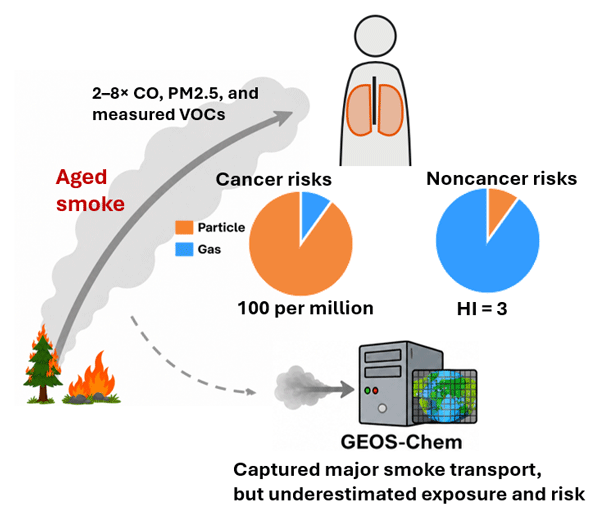
- Particles and gases dominated different screening-level estimates. This was an upper-bound comparison, not an estimate of observed illness. We assumed that a smoke season like 2020 occurred every year for 70 years. Under that scenario, PM₂.₅ accounted for most of the estimated cancer risk, while measured hazardous gases accounted for most of the chronic noncancer estimate.
- Getting the smoke timing right was not enough. GEOS-Chem reproduced the timing of the first two smoke events but underestimated many ground-level pollutants and the resulting screening-level risk estimates.
About the paper
Characterizing emissions, chemistry, and health impacts of aged wildfire smoke in a western US city
Jin et al. Atmospheric Chemistry and Physics (2026) DOI: 10.5194/acp-26-11047-2026
Media: Forbes Montana Public Radio
Official abstract
We report hourly surface observations of PM₂.₅, CO, NOₓ, O₃, and 75 speciated VOCs in Missoula, Montana, during a strong smoke event in 2020. This study tests our current understanding of wildfire emissions, chemistry, and health effects as implemented in the GEOS-Chem chemical transport model. Three-or-more-day-old smoke transported from California and the Pacific Northwest increased CO, PM₂.₅, and total measured VOCs by factors of 2–8, with hourly maxima of 800 ppb, 120 µg m⁻³, and 85 ppb, respectively. In contrast, NOₓ levels were not elevated compared to the urban background. O₃ showed a non-monotonic response to wildfire smoke: MDA8 O₃ increased under light smoke but flattened or declined when PM₂.₅ exceeded ∼ 30–40 µg m⁻³, a feature that GEOS-Chem failed to reproduce. A 2020-style wildfire season recurring annually would yield an excess lifetime cancer risk of 100-in-1 million or approximately 7 times the non-smoke baseline. The chronic non-cancer hazard index (HI) would reach 3.0, indicating appreciable potential for chronic non-cancer effects. About 90 % of cancer risks are from PM₂.₅ whereas non-cancer risks are dominated by formaldehyde, benzene, acrolein, and acetaldehyde. GEOS-Chem captured major smoke intrusions but underestimated CO, PM₂.₅, and VOCs by 30 %–90 %. These model biases propagate to health metrics, with GEOS-Chem underestimating smoke-attributable cancer risk by ∼ 40 % and chronic HI by ∼ 10 times. We attribute the model errors to underpredicted fire emissions and unrepresented VOC chemistry, which together led to an overestimation of OH and insufficient secondary production.
Recommended citation
Jin, L., Tan, L., Ketcherside, D. T., Selimovic, V., Nauman, K., Yokelson, R. J., and Hu, L. (2026). Characterizing emissions, chemistry, and health impacts of aged wildfire smoke in a western US city. Atmospheric Chemistry and Physics, 26, 11047–11066. https://doi.org/10.5194/acp-26-11047-2026