Aircraft Measurements Reveal Missing Wildfire CO and VOC Emissions
Published:
Plain-language summary
The fires were detected, but their modeled CO and VOC emissions were too low.
Wildfire-smoke modeling often begins with satellite observations. Satellites can show where fires are burning, but a fire-emission inventory must still estimate how much fuel burned and how much of each gas entered the atmosphere, including carbon monoxide (CO) and volatile organic compounds (VOCs). We tested those estimates using measurements from two major aircraft campaigns and a network of ground monitors across the western United States.
Four findings
- Similar VOC totals hid very different chemical mixtures. For the 14 VOC groups represented in GEOS-Chem, the three inventories differed by only about 30%–40% in total, but estimates for individual compounds differed by as much as fivefold.
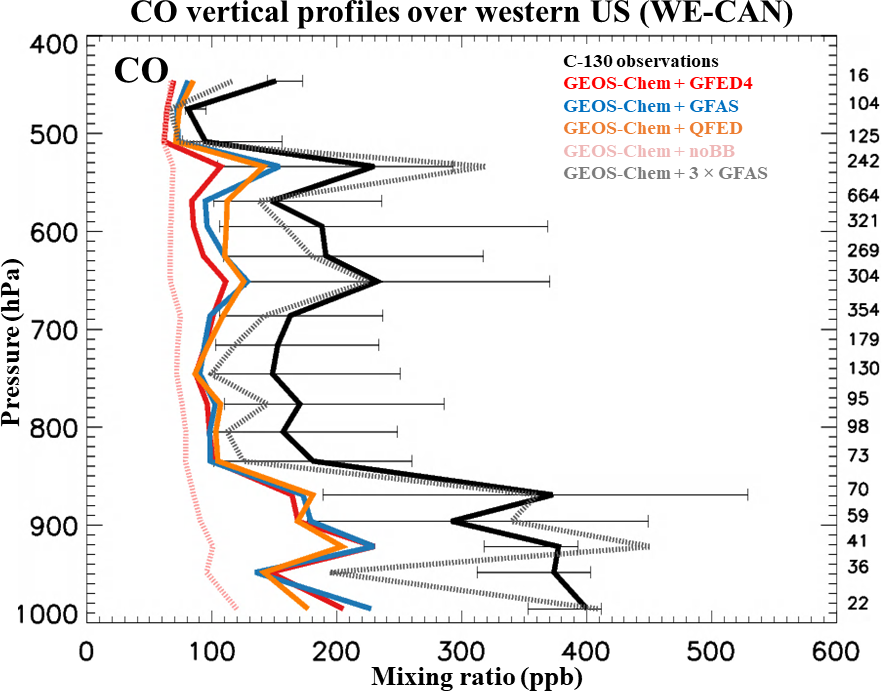
- The inventories included the sampled fires but underestimated their gas emissions. Fire-related increases in CO, propane, benzene, and toluene were only about one-third to one-seventh as large as the increases measured by aircraft.
- Tripling fire emissions improved some gases but left others too low. In the GFAS sensitivity test, directly emitted gases came closer to the observations, but several oxygenated VOCs remained too low. The remaining gaps pointed to missing precursor emissions, incomplete treatment of chemistry that forms oxygenated gases downwind, or both. This diagnostic test does not mean that emissions from every fire should be tripled.
- Aircraft and ground observations supported the same conclusion. Both showed that the model underestimated fire-related CO. In the aircraft data, the model’s 14 biomass-burning VOC groups accounted for only about half of the total VOC-to-CO ratio measured across 161 compounds. After accounting for both the weak modeled fire signal and the VOCs missing from the model, we estimated that wildfires supplied about 45% of western U.S. primary VOC emissions during the intense 2018 fire season and about 10% in 2019.
About the paper
Constraining emissions of volatile organic compounds from western US wildfires with WE-CAN and FIREX-AQ airborne observations
Jin et al. Atmospheric Chemistry and Physics (2023) DOI: 10.5194/acp-23-5969-2023
Media: NOAA Climate.gov
Official abstract
The impact of biomass burning (BB) on the atmospheric burden of volatile organic compounds (VOCs) is highly uncertain. Here we apply the GEOS-Chem chemical transport model (CTM) to constrain BB emissions in the western USA at ∼ 25 km resolution. Across three BB emission inventories widely used in CTMs, the inventory–inventory comparison suggests that the totals of 14 modeled BB VOC emissions in the western USA agree with each other within 30 %–40 %. However, emissions for individual VOCs can differ by a factor of 1–5, driven by the regionally averaged emission ratios (ERs, reflecting both assigned ERs for specific biome and vegetation classifications) across the three inventories. We further evaluate GEOS-Chem simulations with aircraft observations made during WE-CAN (Western Wildfire Experiment for Cloud Chemistry, Aerosol Absorption and Nitrogen) and FIREX-AQ (Fire Influence on Regional to Global Environments and Air Quality) field campaigns. Despite being driven by different global BB inventories or applying various injection height assumptions, the model–observation comparison suggests that GEOS-Chem simulations underpredict observed vertical profiles by a factor of 3–7. The model shows small to no bias for most species in low-/no-smoke conditions. We thus attribute the negative model biases mostly to underestimated BB emissions in these inventories. Tripling BB emissions in the model reproduces observed vertical profiles for primary compounds, i.e., CO, propane, benzene, and toluene. However, it shows no to less significant improvements for oxygenated VOCs, particularly for formaldehyde, formic acid, acetic acid, and lumped ≥ C₃ aldehydes, suggesting the model is missing secondary sources of these compounds in BB-impacted environments. The underestimation of primary BB emissions in inventories is likely attributable to underpredicted amounts of effective dry matter burned, rather than errors in fire detection, injection height, or ERs, as constrained by aircraft and ground measurements. We cannot rule out potential sub-grid uncertainties (i.e., not being able to fully resolve fire plumes) in the nested GEOS-Chem which could explain the negative model bias partially, though back-of-the-envelope calculation and evaluation using longer-term ground measurements help support the argument of the dry matter burned underestimation. The total ERs of the 14 BB VOCs implemented in GEOS-Chem only account for half of the total 161 measured VOCs (∼ 75 versus 150 ppb ppm⁻¹). This reveals a significant amount of missing reactive organic carbon in widely used BB emission inventories. Considering both uncertainties in effective dry matter burned (× 3) and unmodeled VOCs (× 2), we infer that BB contributed to 10 % in 2019 and 45 % in 2018 (240 and 2040 Gg C) of the total VOC primary emission flux in the western USA during these two fire seasons, compared to only 1 %–10 % in the standard GEOS-Chem.
Recommended citation
Jin, L., Permar, W., Selimovic, V., Ketcherside, D., Yokelson, R. J., Hornbrook, R. S., Apel, E. C., Ku, I.-T., Collett Jr., J. L., Sullivan, A. P., Jaffe, D. A., Pierce, J. R., Fried, A., Coggon, M. M., Gkatzelis, G. I., Warneke, C., Fischer, E. V., and Hu, L. (2023). Constraining emissions of volatile organic compounds from western US wildfires with WE-CAN and FIREX-AQ airborne observations. Atmospheric Chemistry and Physics, 23, 5969–5991. https://doi.org/10.5194/acp-23-5969-2023